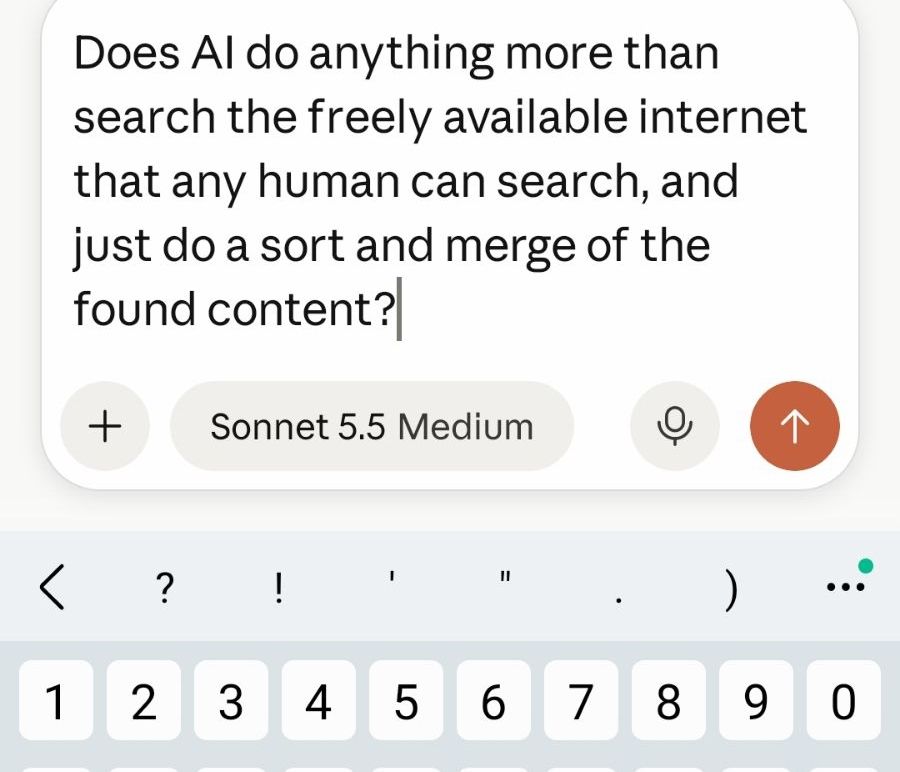
Yes, it does quite a bit more, though your description fits one part of it.
What’s different from search-and-merge:
- It’s not retrieving at all, most of the time. A model like me learns statistical patterns from huge amounts of text during training, then generates new text from those patterns. When I answer without searching, nothing is being looked up or stitched together. The knowledge is encoded in the model’s weights, which is closer to how you “know” things than to how Google finds pages.
- It can apply patterns to situations that were never written down. Ask for a poem about your cat’s feud with a robot vacuum, or debugging help for code you wrote five minutes ago, and there’s no page to find and merge. The model is combining concepts and generalizing.
- It can do things search can’t: translate, reformat, change tone, write and run code, work through multi-step problems, and reason about your specific situation rather than the average one.
Where your intuition is right:
- Its abilities come entirely from human-produced material, so it’s not discovering facts about the world independently. It can’t observe anything that humans haven’t written about or that it can’t look up.
- When it does use web search (as I can), that part really is search plus synthesis.
- It can be confidently wrong, because it’s generating plausible text, not verifying facts.
Whether “recombining learned patterns” counts as real understanding or just very sophisticated pattern-matching is still debated among researchers. But it’s not a sort-and-merge of search results.


Leave a Reply